Help to transform our extraordinary hospital into something even better.
- Refine search:

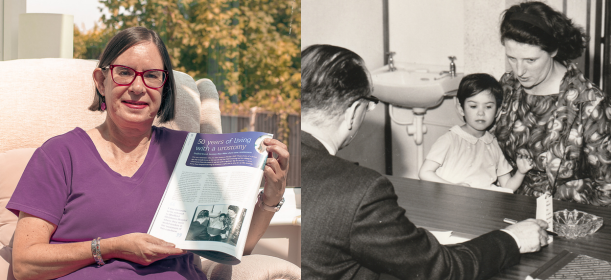
On this day in 1969, the entire world was looking to the stars, awaiting the safe return of the Apollo 11 astronauts from their historic mission to the moon.
Well, maybe not the ENTIRE world.
Because whilst most were huddled round their television sets, five-year-old Mary was looking wistfully out of the window at Sheffield Children’s Hospital towards Weston Park, dreaming of getting home in time for her fifth birthday following a successful procedure.
“The moon landing was obviously a big moment culturally, and I can remember my mum and the ward staff having their eyes glued to a little television, but I just wanted to get home. I wanted to go outside and play and get home in time for my birthday.”
Mary’s Story
Mary was diagnosed with Spina Bifida shortly after her birth in 1964, when she was quickly transferred to Sheffield Children’s Hospital. Over the following years, Mary was a frequent visitor to Sheffield Children’s and underwent a number of procedures to support her mobility and prolong her life.
Mary said: “It was fortunate that I was referred to Sheffield Children’s, who were world leaders in treating my condition. My family would often take a 160-mile round trip from Mablethorpe to access care at Sheffield Children’s, because my mum really trusted the care that I’d receive here.”
Spina Bifida is a condition where the spinal cord, surrounding nerves and or spinal column does not to develop normally during the first 28 days of pregnancy. It can cause long-lasting side effects, including bowel and bladder complications. Shortly before her fifth birthday, Mary underwent a urostomy procedure to support with these complications, which involved the creation of an alternative opening in the body which allows for the safe passage of urine.
Mary’s treatment for Spina Bifida Sheffield Children’s was initially led by world-leading Paediatric Consultant Orthopaedic Surgeon Professor John Sharrard, with support from Professor Robert Zachary and Professor John Lorber. Professor Sharrard and his team supported Mary and mum Eleanor from the moment they first walked through the door at Sheffield Children’s, and thanks to their hard work, Mary returned home in time to blow out the candles on her cake following her urostomy.
Mary said: “Mr Sharrard and his team were very innovative – the overall positivity of the team was amazing. When I arrived at Sheffield Children’s, my mum didn’t know whether I was going to walk or talk but the team were always encouraging and here I am 60 years later!”
Treatment at Sheffield Children’s meant that Mary could continue doing what she loved: playing outside and getting active. Mary particularly enjoyed climbing trees, and recalled how the team at Sheffield Children’s went above and beyond to keep her climbing:
“I always wanted to walk and be outside, and the team at Sheffield Children’s really did everything that they could to help me do that.”
“The Orthotic Department gave me callipers to support my legs. These were initially made from aluminium but used to bend whenever I climbed a tree. So, we spoke to consultants who suggested creating new ones made from iron. They were heavier, but it meant I could get outside and do anything I wanted to!”
Having regularly visited Sheffield Children’s for the first 16 years of her life, Mary built strong connections with nurses and consultants and created a particularly strong bond with a member of our restaurant team.
“The teams at Sheffield Children’s were fantastic, and everybody that I remember was lovely. However, every time we went to the restaurant, we couldn’t wait to see ‘Auntie Rose’. We’d always go and see Auntie Rose and get some lunch. Having been to the hospital so often at that time, we really got to know people and built friendships too.”
Throughout our 150-year history, teams at Sheffield Children’s have helped shape new ways to treat and care for children and young people with spina bifida. In fact, having gained international recognition for his early treatment of the condition at Sheffield Children’s during the 1950s and 1960s, Professor Robert Zachary actually set up the Association for Spina Bifida and Hydrocephalus in 1966 to create further support for patients and families experiencing these conditions. Skilled paediatric surgeons from across the world would travel to Sheffield to learn from Professor Zachary and his team, cementing Sheffield Children’s as a global leader in children’s health in this area and creating a platform for pioneering developments in treatment which have since been made.
What are your memories of Sheffield Children’s? Do you have any historic Sheffield Children’s memorabilia at home which you could share? Visit our webpage to let us know, we’d love to see it:
Your Sheffield Children’s Memories – Sheffield Children’s NHS Foundation Trust
Help to transform our extraordinary hospital into something even better.

By continuing to use the site, you agree to the use of cookies. more information
The cookie settings on this website are set to "allow cookies" to give you the best browsing experience possible. If you continue to use this website without changing your cookie settings or you click "Accept" below then you are consenting to this.
